
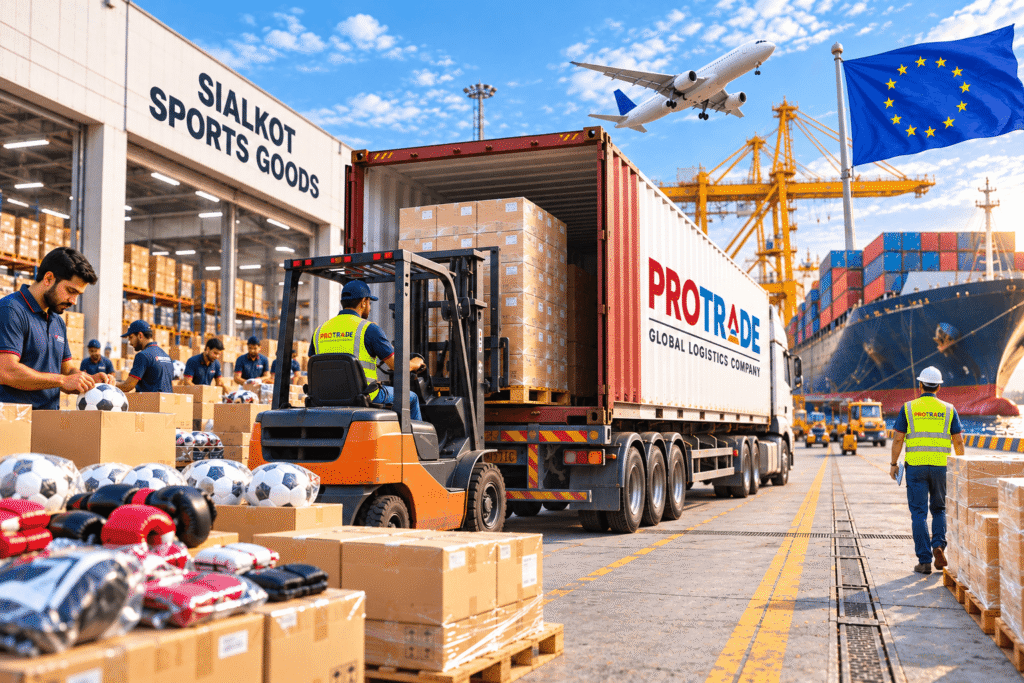
Sialkot Sports Goods Freight Forwarder Europe: Full Guide
Forty cartons of match footballs sit at Karachi Port because one HS code on the packing list does not match the invoice. The vessel sails without them. Your spring restock now lands four weeks late. If you source from Sialkot, you have probably lived a version of this story. The fix is rarely dramatic. It is a Sialkot sports goods freight forwarder Europe buyers can reach by phone, one who checks the paperwork before the truck leaves the factory. At ProTrade Global Logistics, that is the job we do from Karachi: pickup, clearance, stuffing, booking and tracking handled as one chain.This guide covers how freight really moves from Sialkot to Europe, which route fits which order, what paperwork you need, what it costs, and how to pick a partner without getting burned. It is written for European brands, sports equipment buyers, freight brokers and overseas forwarders who want Pakistan to Europe freight forwarding that stays predictable.
Quick Answer
What is the best way to ship sports goods from Sialkot to Europe?
For most orders, sea freight from Karachi or Port Qasim is the practical choice, booked as FCL or LCL on FOB terms. Air freight via SKT or Lahore suits urgent samples and small restocks. The smoothest setup is a Sialkot sports goods freight forwarder Europe buyers can brief once, who handles pickup, export clearance and documents. Expect roughly 25 to 40 days port to port by sea, plus the inland leg.
- Key documents: commercial invoice, packing list, Goods Declaration (WeBOC), bill of lading or airway bill, and a REX origin statement for GSP+ duty benefits.
- Importer needs: an EORI number (GB EORI for the UK).
- Biggest risks: HS code mismatches, missed vessel cut-offs and moisture damage to leather and textiles.
Introduction: Why Sports Goods Shipments from Sialkot Get Delayed
Forty cartons of match footballs sit at Karachi Port because one HS code on the packing list does not match the invoice. The vessel sails without them. Your spring restock now lands four weeks late. If you source from Sialkot, you have probably lived a version of this story. The fix is rarely dramatic. It is a Sialkot sports goods freight forwarder Europe buyers can reach by phone, one who checks the paperwork before the truck leaves the factory. At ProTrade Global Logistics, that is the job we do from Karachi: pickup, clearance, stuffing, booking and tracking handled as one chain.
This guide covers how freight really moves from Sialkot to Europe, which route fits which order, what paperwork you need, what it costs, and how to pick a partner without getting burned. It is written for European brands, sports equipment buyers, freight brokers and overseas forwarders who want Pakistan to Europe freight forwarding that stays predictable.
Why Sialkot Still Dominates Global Sports Goods Manufacturing
Sialkot is a mid-sized city with an outsized reputation. For decades its workshops and factories have produced footballs, boxing and martial arts gear, motorcycle leathers, sports gloves, team uniforms and technical sportswear for brands across Europe. Many of those brands never mention Pakistan on the label. The work still starts here.
Need Help With Your Shipment?
Talk to ProTrade Global Logistics Company about your import or export requirements.
WhatsApp ProTrade Global Logistics NowWhy do buyers keep coming back? Three reasons come up in almost every sourcing conversation. Quality that holds up on the pitch and in the wash. Minimum order quantities that smaller labels can actually meet. And lead times that suppliers will flex when a season shifts. Factories here also handle a lot of customisation, from panel designs to private-label packing, which suits European clubs and mid-sized brands that do not order in the hundreds of thousands.
The catch sits outside the factory gate. Sialkot is inland. Your goods have to travel from an industrial estate in Punjab to a vessel at Karachi or Port Qasim, or onto a flight, and the paperwork has to survive every handover. That is where good orders go wrong.
Where European Buyers Lose Time and Money When Sourcing from Sialkot
Most delays are not caused by one big failure. They come from small gaps that stack up. These are the ones we see most often in Pakistan sports goods exporters logistics:
- Customs holds. A small mismatch between the commercial invoice, packing list and Goods Declaration can freeze a container for days. Wrong HS codes and vague product descriptions are the usual suspects.
- Missed vessel cut-offs. Terminals in Karachi publish cut-off times for each sailing. If the truck arrives late, the cargo rolls to the next vessel. That can cost one to two weeks.
- Container shortages. Equipment gets tight before peak season. Without an early booking, you may wait for a box or pay more for one.
- Unclear local charges. A quote that says freight only and ignores terminal handling, documentation and dry port fees will not stay that low once the invoice arrives.
- Poor tracking. Cargo goes quiet between the factory and the port. Nobody can say if it is at the dry port, on a truck or stuck in a queue.
Each of these is fixable, but only if someone owns the whole chain from the factory floor to the vessel.
Air, Sea or Road Feeder? Route Planning for Sialkot Sports Goods Freight Forwarder Europe Shipments
There is no single best route. The right one depends on order value, urgency and how much stock you can afford to have sitting on the water. Here is how the options compare.
Air freight: Sialkot International Airport (SKT) or trucking to Lahore (LHE)
Air makes sense for urgent samples, small replenishment orders and high-value items. Flying out of SKT keeps cargo close to the factory, but European connections are often limited and may run through Gulf hubs. Trucking to Lahore adds a road leg and extra handling, yet it usually gives access to more airlines and more capacity. For time-critical lots, compare both options on the day you ship, not from last month's schedule.
Sea freight: Karachi Port and Port Qasim
Sea freight carries most volume from Sialkot to Europe. Goods move by road or rail to Karachi, then sail to ports such as Rotterdam, Antwerp, Hamburg or, for the UK, Felixstowe. On many services, Karachi to Rotterdam shipping takes roughly 25 to 40 days port to port, plus the inland leg and any transhipment. That range moves with the carrier, the season and the routing, so always ask for the current schedule.
FCL or LCL consolidation
If you can fill a 20 foot or 40 foot container, FCL gives you more control, a sealed box and usually a lower cost per carton. If your order is smaller, LCL consolidation from Sialkot lets you share container space with other cargo. The trade-off is extra handling at origin and destination, so packing quality matters even more.
When each mode makes sense
- Urgent samples and sales kits: air freight, or express courier for parcel-size lots.
- Seasonal restocks: air for the first wave, sea for the rest.
- Bulk replenishment: FCL by sea, booked early.
- Mixed orders from several factories: LCL or a consolidated FCL.
Air Freight vs Sea FCL vs Sea LCL: Quick Comparison
Not sure which mode fits your order? This table shows how the three main options from Sialkot compare on the points that usually decide the choice.
| Factor | ✈️Air Freight | 🚢Sea Freight (FCL) | 📦Sea Freight (LCL) |
|---|---|---|---|
| Best for | Urgent samples, sales kits, small restocks and high-value items | Bulk replenishment and large seasonal orders | Smaller orders and mixed cargo from several suppliers |
| Typical speed | Usually a few days to about a week, depending on routing and connections | Roughly 25 to 40 days port to port, plus the inland leg | Similar sailing time, plus waiting for consolidation at origin and destination |
| Cost level | Highest cost per kilo | Lowest cost per carton once the container is well filled | Moderate, but often higher per cubic metre than FCL |
| Volume suited | Small to medium weights | A full 20 foot or 40 foot container | Part loads that do not fill a container |
| Main risks | Limited capacity at peak times and fewer direct flights to Europe | Moisture damage on long sea legs and rolled cargo if the cut-off is missed | Extra handling, higher damage risk and delays if other cargo in the consolidation is held |
| Handling points | Fewer handovers, with a possible road leg to Lahore (LHE) | Sealed at stuffing and opened at destination, so fewer touches | Opened and re-packed at the consolidation warehouse at each end |
| Good to know | Compare SKT and LHE schedules on the day you ship | Book early before peak season to secure equipment | Strong packing and clear carton marks matter even more |
Speeds and costs are general ranges. They change with the carrier, season and routing, so ask for a current quote before you plan.
Working with a specialist Sialkot sports goods freight forwarder Europe buyers can brief once keeps these decisions from turning into last-minute scrambles.
Temperature and Moisture Control for Leather, Synthetic Balls and Textiles
Long sea legs and humid ports are hard on leather and fabric. Cartons that look fine at the factory can arrive with mould spots, warped panels or damp labels. Prevention is cheap compared with a claim.
- Start with dry goods in dry cartons. Pack only after products and packaging have stabilised.
- Use desiccants inside the container and, where needed, extra liners or wraps on cartons.
- Choose strong cartons and keep stacking height sensible so the bottom layer does not crush.
- Palletise on ISPM 15 compliant wooden pallets and keep cartons off the floor.
- Inspect the container before stuffing. Look for holes, damp floors and any smell of mould or chemicals.
- Take photos at stuffing and record the seal number.
For temperature-sensitive cargo, reefer and temperature-controlled options exist, and your forwarder can tell you whether a given product justifies the extra cost.
Ask your forwarder for photos of the empty container, the loaded pallets and the sealed door with the seal number visible. If a moisture or damage claim comes up later, those photos are your evidence.
Incoterms Explained for Sialkot Shipments (EXW, FOB, CIF)
Incoterms decide who pays for what and where risk moves from seller to buyer. Misunderstanding them is a quiet cause of disputes.
- EXW (Ex Works): the buyer takes responsibility from the supplier's door. That includes loading, export clearance and inland transport in Pakistan. It is cheap on paper but demanding in practice.
- FOB (Free On Board): the seller handles export clearance and delivers the goods on board the vessel at the Pakistani port. Risk passes once the cargo is on board.
- CIF (Cost, Insurance and Freight): the seller pays freight and a minimum level of insurance to the destination port. Risk still passes at loading, which surprises some buyers.
Most European buyers settle on FOB Karachi shipping because export clearance stays with someone who knows the local process, and the buyer controls the ocean leg. For containerised cargo, the ICC points out that FCA often fits better than FOB, so it is worth asking your forwarder which term suits your setup. Whichever term you choose, write it into the purchase order clearly, with the named port.
Export Documentation from Pakistan to Europe
Sports goods export documentation is not complicated, but it has to be consistent. Every document should tell the same story: same consignee, same description, same quantities, same HS code.
- Commercial invoice and packing list: accurate descriptions, weights, carton counts and values.
- Bill of lading (sea) or airway bill (air): built from the shipping instructions, so errors here travel everywhere.
- Goods Declaration (GD): filed through Pakistan Customs' WeBOC system for export clearance.
- Certificate of origin and REX origin statement: the proof of origin that supports duty benefits under GSP+. The exporter needs to be registered in the REX system and place the origin statement on the invoice. Registered exporter status for Pakistan sits with your supplier, so check it early.
- HS code classification: sports goods sit across several chapters. Footballs, boxing gear, gloves and sportswear do not share one code, and misclassification is a common reason for questions at customs.
You may see Form E mentioned online. That form belongs to Pakistan-China trade and does not apply to EU shipments.
Clearance for many Sialkot exports runs through Sambrial Dry Port, where containers are stuffed, inspected and cleared before moving on to the seaport. Sambrial Dry Port clearance goes faster when the paperwork is complete before the truck arrives, and slower when someone is still correcting a description at the gate.
Before the truck leaves the factory, ask for a draft copy of the invoice, packing list and Goods Declaration and compare them side by side. Same consignee, same description, same quantities, same HS code. Most customs holds come from a small mismatch that could have been caught at this stage.
EU and UK Import Requirements: EORI, VAT and Destination Handling
The Pakistani side is only half the journey. Your cargo also has to clear customs in Europe.
- EORI number: the importer of record in the EU needs one. UK imports require a separate GB EORI.
- Import VAT and duty: payable at entry unless you use a deferral or postponed accounting arrangement. Correct HS codes and proof of origin decide how much duty you pay.
- Customs entry: filed at the port of arrival, such as Rotterdam, Antwerp, Hamburg or Felixstowe, usually by a customs broker or your destination agent.
- Destination handling: terminal fees, delivery order release, container pick-up and trucking to your warehouse.
The UK is outside the EU scheme and runs its own preference system, the Developing Countries Trading Scheme. Rules and eligibility can change, so confirm current requirements with your broker before you finalise pricing for UK-bound goods.
A good destination agent chases the delivery order, books the customs slot and warns you about demurrage before it starts. Choose one who answers quickly.
GSP+ and Pakistan Exports: What It Means for Your Landed Cost
GSP+ Pakistan exports can enter the EU at reduced or zero customs duty when they meet the origin rules and carry valid proof of origin. For a European importer, that can lower landed cost and improve margin on sports goods, especially on larger volumes.
The benefit is conditional, though. Goods must qualify as originating in Pakistan, the HS code must be right, and the REX origin statement must be correct. A typo or a missing statement can turn a duty-free shipment into a duty bill.
The scheme itself is also under review. The EU has been moving toward a revised GSP framework, and Pakistan is expected to reapply under it. Before you sign long-term contracts or price a season, check the current status on official EU sources such as the European Commission's trade pages.
Shipping Reliability After Red Sea and Suez Disruptions
Red Sea and Suez disruptions changed how many carriers route Asia to Europe services. Some vessels have sailed around the Cape of Good Hope, which adds days and makes schedules less predictable. Port calls, transit times and rates have moved with it.
Situations like this change, so the practical advice stays the same. Book earlier than you used to. Build a buffer into your delivery dates. Ask your forwarder which routing the carrier is using on your lane today, not last quarter. Keep your customers informed with a date range rather than a single promise.
Why You Need a Local Pakistani Routing Agent
Overseas forwarders and European buyers can run perfectly good operations from a distance, but sports goods shipments from Sialkot involve many small physical steps that someone has to witness. That is why a local routing agent matters. A good Sialkot sports goods freight forwarder Europe buyers hire from afar acts as your eyes at the factory gate.
For routing orders and nominations, the agent receives your booking details and turns them into a working plan: pickup dates, vessel, documents, tracking. A trusted Pakistan freight forwarding partner can also coordinate several suppliers at once, so the buyer sees one status instead of five.
For sports goods, the most valuable work happens at stuffing. Checking carton counts against the packing list, confirming palletisation, spotting damp cartons and photographing the loaded container prevents problems that are impossible to fix once the box is sealed.
For routing orders and nominations, the agent receives your booking details and turns them into a working plan: pickup dates, vessel, documents, tracking. A trusted Pakistan freight forwarding partner can also coordinate several suppliers at once, so the buyer sees one status instead of five.
ProTrade works from Karachi and covers the origin side of the shipment, including:
- EXW factory pickup anywhere in Pakistan, and FCA or FOB export handling.
- FCL and LCL sea freight, plus air freight exports.
- Export customs clearance, container transportation and stuffing.
- Karachi Port and Port Qasim handling.
- Export documentation and bill of lading coordination.
- Pre-alerts, shipment monitoring and supplier coordination.
For sports goods, the most valuable work happens at stuffing. Checking carton counts against the packing list, confirming palletisation, spotting damp cartons and photographing the loaded container prevents problems that are impossible to fix once the box is sealed.
What Does Freight from Sialkot to Europe Really Cost? A Breakdown of Charges
Nobody can quote a fair price without knowing your cargo, volume, port pair and dates. What you can do is understand what goes into the price so you can compare quotes properly.
- Main freight: ocean or air rate, plus carrier surcharges.
- Terminal handling charges (THC): at the origin port, and again at destination.
- Inland haulage: trucking or rail from Sialkot to the dry port or seaport.
- Documentation fees: bill of lading, customs filing and certificates.
- Dry port and port charges: handling, storage and inspection costs where they apply.
- Destination charges: delivery order, customs clearance, trucking and any storage.
- Insurance: optional on some terms, strongly advised for leather and textile cargo.
To spot hidden local charges, ask for a door-to-port or door-to-door quote that lists every line item and the date the quote expires. Ask what is excluded. Ask how detention and demurrage are handled. A cheap headline rate with a long list of exclusions is rarely cheap.
Choosing a Sialkot Sports Goods Freight Forwarder Europe Can Rely On
The right partner saves you more than the lowest quote ever will. Use this checklist when you compare options:
- Network strength: agents and partners at your destination ports, not just in Karachi.
- Origin capability: factory pickup, stuffing supervision and warehouse or consolidation options.
- Carrier relationships: access to space on the services you need, with clear booking confirmations.
- Transparent quoting: every charge listed, with validity dates.
- Documentation accuracy: someone who checks HS codes and descriptions before filing.
- Communication speed: clear answers within the same working day.
- Claims handling: a process for damage or delays, and honesty when things go wrong.
A few red flags to watch for:
- A quote that is much lower than everyone else's with no breakdown.
- Vague answers about who does the customs filing.
- No tracking updates between pickup and sailing.
- Promises of exact transit times with no mention of season or routing.
- Reluctance to share a sample document set or a reference.
Frequently Asked Questions
What is the average transit time for ocean freight from Sialkot to major European ports?
Ocean freight from Karachi to North European ports such as Rotterdam, Antwerp and Hamburg usually takes roughly 25 to 40 days port to port, depending on the carrier, the service loop and whether cargo is transhipped. Add several days for the inland leg from Sialkot to Karachi and for export clearance. Red Sea routing changes, congestion and peak season can stretch these ranges, so treat any figure as an estimate and ask for the live schedule when you book.
What is the difference between FOB and EXW when shipping from Sialkot?
Under EXW the buyer takes responsibility from the supplier's door, including loading, export clearance and inland transport in Pakistan. Under FOB the supplier or its forwarder handles those steps, and risk passes once the goods are on board at the Pakistani port, usually Karachi. FOB is easier for most European buyers because export clearance stays with someone who knows the local process. For containerised cargo, FCA is often a closer fit, so discuss it with your forwarder.
What documents are required to clear sports equipment customs at Sambrial Dry Port?
Expect a commercial invoice, a packing list, a Goods Declaration filed through WeBOC, and shipping instructions that feed the bill of lading. For EU duty preference you also need a REX origin statement on the invoice or a certificate of origin, depending on the shipment. Some products need extra approvals. Requirements vary by commodity and can change, so confirm the current checklist with your customs agent before stuffing.
How do GSP+ regulations benefit European importers buying sports goods from Pakistan?
GSP+ allows eligible Pakistani goods to enter the EU at reduced or zero customs duty when they meet origin rules and carry the right proof of origin. For importers this lowers landed cost and can improve margin on sports goods. The benefit depends on correct HS classification and a valid REX origin statement. The scheme is under review and Pakistan is expected to reapply under the EU's revised framework, so check official EU sources before pricing long-term contracts.
Do I need an EORI number to import sports goods from Pakistan into Europe?
Yes. The importer of record in the EU needs an EORI number to lodge customs declarations, and UK imports need a separate GB EORI. A Pakistani supplier does not usually need one for this purpose. If you use a customs representative or an agent, confirm whose EORI appears on the entry before the vessel arrives, because errors here cause delays at the port.
How much does it cost to ship sports goods from Sialkot to Rotterdam or Hamburg?
There is no single price. Ocean freight from Sialkot to Rotterdam or Hamburg depends on container size, carrier, season and surcharges, and you should add inland haulage, terminal handling, documentation, dry port or port charges, insurance and destination costs. Ask for an all-in quote broken into each line item, with a validity date. Rates move with the market, so a quote from last quarter is not a reliable guide.
How does air freight via Sialkot International Airport (SKT) compare to road feeder transit to Lahore (LHE)?
Flying from SKT keeps cargo close to the factory, but flight options to Europe are usually limited and may route through Gulf hubs. Trucking to Lahore gives access to more airlines and capacity, which can mean better schedules, at the cost of a road leg and extra handling. For urgent samples or replenishment, compare both options with your forwarder on the day you ship.
What HS codes are used for football, boxing gear and sportswear exports?
Common codes include 9506.62 for inflatable balls such as footballs, 9506.99 for many other sports items including boxing equipment, 4203.21 for certain leather gloves made for sport, and chapters 61 or 62 for sportswear and uniforms. The right code depends on material and construction, so confirm classification with your customs broker. A mismatch between the invoice, packing list and GD is a common cause of holds.
How do you protect leather and synthetic balls from moisture damage during ocean freight?
Start with dry goods and dry cartons, then add desiccants, sturdy cartons and liners where needed. Inspect the container for holes, damp floors and odour before stuffing, pack on ISPM 15 compliant pallets and keep cartons off the floor. Photograph the stuffing and record the seal number. Insurance helps if something goes wrong, but prevention matters more, because leather and textiles absorb humidity quickly on long sea legs.
Can ProTrade handle small LCL shipments or sample courier deliveries from Sialkot?
ProTrade handles LCL sea freight and air freight exports from Pakistan and can coordinate pickup from your supplier. For parcel-size samples, an express courier is usually the more practical choice. For larger sample batches, air freight or LCL often works better. Share the weight, volume and destination, and the team can suggest the option that fits your timeline and budget.
Can a freight forwarder in Pakistan handle ex-factory pickup and consolidation from multiple Sialkot suppliers?
Yes. A Sialkot sports goods freight forwarder Europe buyers work with can collect cartons from several factories under EXW terms, check them against each purchase order, consolidate them into one container or LCL shipment and issue one set of shipping documents. This saves freight cost and cuts the number of bookings you manage. It needs good supplier coordination and a clear cut-off date for each factory.
How far in advance should European buyers book shipments from Pakistan before peak season?
Book as early as your supplier's production plan allows, often several weeks before cargo readiness, and share forecasts with your forwarder. Space and equipment tighten before major sporting seasons and year end, and schedules are less predictable when routes change. Early booking gives you time to fix documents and avoid rolled cargo. Ask your forwarder for current lead-time advice on your specific lane.
Ready to Ship? Request a Routing Quote
Sialkot makes some of the best sports goods in the world. Getting them to Europe on time, with the right paperwork and no surprise charges, is a separate skill. A reliable Sialkot sports goods freight forwarder Europe logistics directors, buyers and overseas forwarders can call when something changes is worth more than a few dollars saved on a quote.
If you are planning a new order, a seasonal restock or a long-term routing arrangement from Pakistan, send ProTrade your cargo details, supplier location, destination port and target dates. We will come back with a clear routing plan and a quote that shows every line. You can also reach out to set up a partnership as a Pakistan origin agent for your European shipments.