COC vs SOC Container Pakistan Export: A Simple Guide for Overseas Forwarders
If you are a freight forwarder moving cargo out of Pakistan, one question comes up again and again: should the shipment go in a carrier-owned container or a shipper-owned one? The COC vs SOC container Pakistan export choice looks small, but it changes how the booking is made, who looks after the box, and what can go wrong if plans change.
This guide explains it in plain words. We wrote it as the origin team at ProTrade Global Logistics, so you will also see how things work on the ground at Karachi Port and Port Qasim.
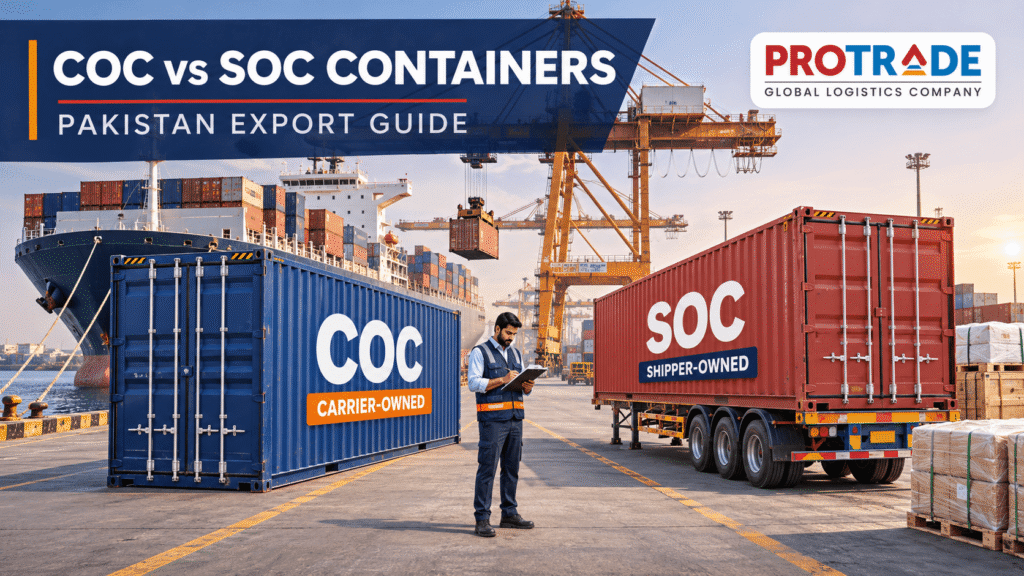
A COC is a container that belongs to the shipping line. An SOC is a container that belongs to the shipper or to a leasing company. For most standard FCL cargo, COC is the simple choice. SOC can work for certain repeat or one-way moves, but the shipping line has to accept it first. The right answer for your COC vs SOC container Pakistan export shipment depends on the route, the cargo and what the line allows.
- Who owns the container, the line or the shipper?
- Does the shipping line accept an SOC on this route?
- Which port will you use, Karachi Port or Port Qasim?
- Is the shipment EXW or FOB, and who is booking?
Need a Pakistan Origin Agent for Your Next EXW or FOB Shipment?
Send us your supplier location, cargo details, shipping terms and destination port. Our Karachi team will plan the Pakistan side with you.
Message Our Karachi Team on WhatsAppWhat Is a COC Container?
COC means carrier-owned container. The shipping line owns the box and supplies it for your booking. The line sets the free time and tells you where the empty container must go back. When someone says “book it on a COC”, they mean the line provides the container and you ship under the line’s terms.
What Is an SOC Container?
SOC means shipper-owned container. The shipper owns or leases the box, and the line only carries it on the vessel. So you book space, not equipment. Most lines want to approve an SOC before booking, and the box must be in good condition and meet the line’s rules. Not every line takes SOC on every route.
COC vs SOC Container Pakistan Export: Side-by-Side Comparison
| Point | COC (Carrier-Owned) | SOC (Shipper-Owned) |
|---|---|---|
| Who owns the box | The shipping line | The shipper or a leasing company |
| What you book | Container and vessel space | Vessel space only |
| Line approval | Standard booking | Usually needed before booking |
| Return of the empty box | Goes back to the line’s depot within the free time | No return to the line, the owner decides what happens next |
| Detention risk | Line charges can apply if the box is kept too long | No line detention on your own box, but port and terminal charges can still apply |
| Upfront cost | Low, the line supplies the box | Higher, someone must own or lease the container |
| Box condition | The line is responsible for its equipment | The owner must keep it in good, accepted condition |
| Usually suits | Standard FCL cargo on common routes | Repeat, one-way or special moves, if the line agrees |
Terms differ between shipping lines, so ask the line to confirm whether it accepts your SOC on the route before the supplier loads anything. For standard cargo, a COC keeps things simple.
When COC Is the Better Fit for Pakistan Export
For most FCL shipments out of Pakistan, COC is the easy route. Textiles, garments, leather, sports goods and many other everyday cargoes usually move this way. The line gives the container, and your origin agent handles pickup, stuffing and delivery to the port. In a typical COC vs SOC container Pakistan export decision, COC wins when the cargo is standard, the route is common and nobody in the chain owns containers.
When SOC Can Make Sense
SOC is worth a look when a shipper or buyer already owns or leases containers and the line is happy to carry them. It can suit repeat shipments or moves where getting an empty box back is hard. Check three things first: does the line accept it, is the container in good shape, and who deals with it at the destination?
Karachi Port vs Port Qasim: Does It Change Your Container Choice?
Pakistan has two main sea gateways for export containers: Karachi Port, run by Karachi Port Trust, and Port Qasim, run by Port Qasim Authority. Your COC vs SOC container Pakistan export plan should say which port the container will use, because the line’s depot, handling steps and timing depend on it. ProTrade Global Logistics handles cargo through both ports.
How EXW and FOB Shipments Work With COC and SOC
Under EXW, the supplier makes the goods available at its own premises and the buyer side arranges collection. Under FOB, the seller delivers the goods on board the vessel at the port of loading. You can read the official definitions in the ICC Incoterms 2020 rules.
With EXW and FOB routing orders, the buyer names its own freight forwarder. That forwarder sends the routing order to the origin agent in Pakistan, who runs the shipment at origin. Your COC vs SOC container Pakistan export choice should be clear before that handover happens. See how it works on our routing orders and nominations page.
How ProTrade Global Logistics Handles COC and SOC Containers From Pakistan
ProTrade Global Logistics is a freight forwarding company based in Gulshan-e-Iqbal, Karachi. As your origin agent, we work with your shipper, the shipping line and the port so your cargo moves without confusion. Our Pakistan origin services include:
- EXW factory pickup anywhere in Pakistan
- FCL and LCL shipments
- Container transportation and stuffing
- Karachi Port and Port Qasim handling
- COC and SOC containers
- Export documentation and BL coordination
- Supplier coordination, pre-alert and shipment monitoring
That means our COC vs SOC container Pakistan export support covers both box types. We are also a member of PIFFA and other recognized bodies, which are listed further down this page.
EXW, FOB, COC and SOC Support for Pakistan Export
EXW Export Shipments
We arrange pickup from the supplier’s factory and coordinate the Pakistan side from the agreed collection point.
FOB Export Shipments
We look after Pakistan-side export, customs, documents and port coordination for your shipment.
COC, SOC and Reefer Support
We coordinate COC and SOC containers, plus reefer equipment and temperature-sensitive cargo, where your shipment needs it.
ProTrade Global Logistics: Memberships, Licenses and Recognized Bodies
When you nominate an origin agent, you trust them with your client’s cargo. So it helps to know who they work with and what they are registered with. ProTrade Global Logistics was founded in 2008 and is based in Karachi. Here is where we stand:
Certified Transportation Network
Exclusive member of this global alliance of logistics service providers.
Overseas Project Cargo Association
Member of this network of project cargo agents.
PIFFA
Member of the Pakistan International Freight Forwarders Association.
Pakistan Customs
Freight forwarding license holder.
Federal Board of Revenue
Registered with the FBR.
Karachi Chamber of Commerce and Industry
Member of the Karachi Chamber.
Our CEO, Muhammad Arif Qadeer, is a FIATA certified trainer in Pakistan. FIATA is the international federation of freight forwarders associations. He has over two decades of experience in international freight forwarding and logistics, and he leads the team that looks after your shipment at origin.
Memberships and licenses do not replace your own checks, but they are a useful first sign of who you are dealing with. You can see all our logos and details on our affiliations page.
Step-by-Step: How to Choose Between COC and SOC
Follow these steps for every COC vs SOC container Pakistan export booking:
- Confirm the incoterm (EXW or FOB) and who is making the booking.
- Ask the shipping line if it accepts an SOC on your route.
- Choose the port, Karachi Port or Port Qasim.
- Share the cargo readiness date and supplier details with your origin agent.
- Agree who handles the empty box after delivery.
- Check the documents and BL details before loading.
Decide COC or SOC before your supplier is ready, so the booking, the pickup and the port plan all match from day one.
Common Mistakes to Avoid
- Assuming the line will accept an SOC without asking.
- Choosing the container type after the supplier is already ready.
- Forgetting the return rules on a COC.
- Not telling the origin agent which port you want.
- Sending different names or details on the booking and the documents.
Export Documents and Customs in Pakistan
Export paperwork in Pakistan runs through the customs system and the Pakistan Single Window. Ask your origin agent to check names, weights and BL details before loading, since small mistakes can hold up a container. A clear plan for COC vs SOC container Pakistan export keeps the paperwork straight from the start.
Nominate ProTrade Global Logistics as Your Pakistan Origin Agent
The short version: COC vs SOC container Pakistan export comes down to who owns the box, what the line accepts, and who handles it at each end. ProTrade Global Logistics is a PIFFA member and a freight forwarding license holder with Pakistan Customs, so you know who is handling the origin side. If you want a team in Karachi to take care of the origin side, you can nominate ProTrade Global Logistics on your next routing order or talk to us first. You can also see our Pakistan export freight partner page and our sea freight services.
COC vs SOC Container Pakistan Export: Frequently Asked Questions
Q. What is the difference in COC vs SOC container Pakistan export?
A. A COC belongs to the shipping line, and an SOC belongs to the shipper or a leasing company.
Q. What does COC mean in shipping?
A. It means carrier-owned container, a box owned by the shipping line.
Q. What does SOC mean in shipping?
A. It means shipper-owned container, a box owned or leased by the shipper.
Q. Which is more common for Pakistan exports?
A. COC is the usual choice for standard FCL cargo.
Q. Does an SOC need approval from the shipping line?
A. In most cases yes, the line should approve it before you book.
Q. Can I use an SOC from Karachi Port and Port Qasim?
A. It depends on the shipping line and the route, so check before you book.
Q. Does SOC remove all extra charges?
A. No. You avoid the line’s detention on its own container, but port and terminal charges can still apply.
Q. Who decides between COC and SOC?
A. The forwarder, the shipper and the shipping line decide together, with input from the origin agent.
Q. Does ProTrade Global Logistics handle both COC and SOC containers?
A. Yes, both are part of our Pakistan origin services.
Q. Can you arrange EXW pickup from my shipper?
A. Yes, we arrange EXW factory pickup anywhere in Pakistan.
Q. Do you handle FCL and LCL shipments?
A. Yes, we handle both FCL and LCL.
Q. Which ports do you work with?
A. We handle cargo through Karachi Port and Port Qasim.
Q. How do I appoint ProTrade Global Logistics as my origin agent?
A. Nominate us on your routing order or message us on WhatsApp, and see our nominations page for details.
Q. Is ProTrade Global Logistics a member of PIFFA?
A. Yes, we are a member of the Pakistan International Freight Forwarders Association (PIFFA).
Q. Which recognized bodies is ProTrade Global Logistics connected with?
A. We are an exclusive member of CTN, a member of OPCA, PIFFA and the Karachi Chamber of Commerce and Industry, a freight forwarding license holder with Pakistan Customs, and registered with the Federal Board of Revenue.
Q. Who is the FIATA certified trainer at ProTrade Global Logistics?
A. Our CEO, Muhammad Arif Qadeer, is a FIATA certified trainer in Pakistan.
Official Links and Sources
- ICC: Incoterms 2020 rules
- Pakistan Single Window
- Karachi Port Trust
- Port Qasim Authority
- Pakistan International Freight Forwarders Association (PIFFA)
- FIATA: International Federation of Freight Forwarders Associations
- Karachi Chamber of Commerce and Industry
- Federal Board of Revenue
- Pakistan Customs
- ProTrade Global Logistics: Our Affiliation
Ready to Nominate ProTrade Global Logistics as Your Pakistan Origin Agent?
Send your routing order details and cargo information. Our team in Karachi will start coordinating with the shipper.
Request a Quote Chat on WhatsApp