LCL Consolidation Pakistan to Europe: Types, Process and Benefits for Freight Forwarders
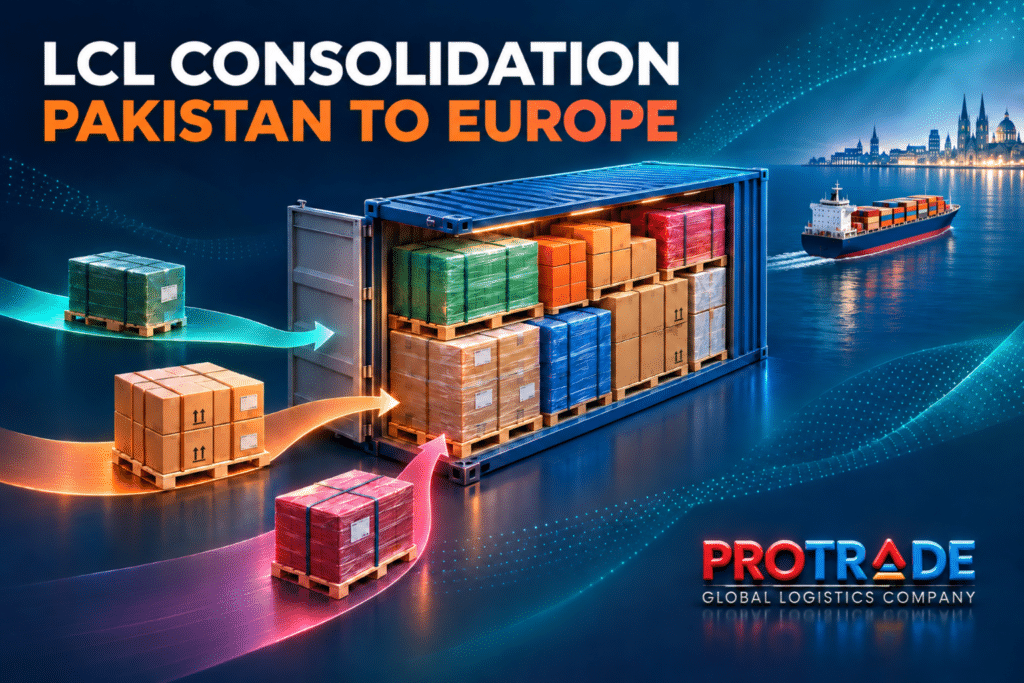
Not every shipment is big enough to fill a container. A buyer in Germany may order from three small factories in Pakistan. A forwarder in Rotterdam may have clients who ship only a few pallets at a time. For these shipments, LCL consolidation Pakistan to Europe is often the practical answer. Cargo from different shippers is combined in one container, so each party pays only for the space it uses.
This guide explains how it works, the three types of consolidation, what affects the cost, and what to check before you book. It comes from the origin team at ProTrade Global Logistics, a freight forwarding company in Karachi. You can also see our full list of consolidation services on our services page.
LCL means less than container load. In LCL consolidation, goods from several shippers are combined in one container at origin and separated again at the destination port. It is a forwarder to forwarder service, so it helps small shippers who cannot fill a full container (FCL). For LCL consolidation Pakistan to Europe, there are three common types: general, buyer’s and seller’s consolidation. The right one depends on how many shippers and consignees are in the shipment.
- Is your cargo too small to fill a full container?
- How many shippers and how many consignees are involved?
- Will you use Karachi Port or Port Qasim?
- Is the shipment EXW or FOB?
- LCL consolidation Pakistan to Europe lets small shippers share one container and pay for the space they use.
- It is a forwarder to forwarder service, from the origin in Pakistan to the port of destination.
- There are three types: general (many shippers, many consignees), buyer’s (many suppliers, one consignee) and seller’s (one shipper, many consignees).
- Choose LCL when your cargo cannot fill a container. Choose FCL when it can.
- ProTrade Global Logistics handles all the required documents from its side for the shipping line, and works through Karachi Port and Port Qasim.
- Rates depend on volume, weight, cargo type, route and timing, so ask for a quote.
Have Small Cargo From Pakistan? Let’s Plan Your Consolidation.
Send us your supplier location, cargo details and destination port. Our Karachi team will plan the consolidation with you.
Talk to Our Consolidation Team on WhatsAppWhat Is LCL Consolidation Pakistan to Europe?
In LCL consolidation Pakistan to Europe, a consolidator collects cargo from different shippers, combines it into one container, and handles the booking with the shipping line. At the destination port, the container is opened, each consignee’s cargo is separated, and the goods are released. Many European forwarders call this “groupage”.
It works between forwarders. An overseas forwarder passes its client’s cargo to an origin agent in Pakistan, and the origin agent combines and ships it. For small shippers, it is a way to use sea freight without paying for a whole container.
Why Freight Forwarders Use LCL Consolidation Pakistan to Europe
- Small shippers can still ship by sea. They pay for the space they use, not the whole container.
- Forwarders can serve more clients. Smaller orders become possible to handle.
- One team coordinates the Pakistan side. Pickup, documents and port handling are planned together.
- Smaller, more regular shipments. Buyers do not have to wait until they have enough cargo for a full container.
Types of LCL Consolidation: General, Buyer’s and Seller’s
The difference between the three types is simple: how many shippers and how many consignees are in the shipment.
| Point | General | Buyer’s | Seller’s |
|---|---|---|---|
| Shippers | Many | Many (suppliers) | One |
| Consignees | Many | One | Many |
| Who it helps | Small shippers sharing a container | A buyer sourcing from several suppliers | An exporter selling to several buyers |
| At origin | Cargo combined at the port of loading | Supplier cargo combined for one consignee | Cargo split by buyer and loaded together |
| At destination | De-consolidated for each consignee | Delivered to one consignee | De-consolidated for each buyer |
| Documents | Separate documents per shipment | Documents prepared for one combined shipment | Separate documents per buyer |
Tell your origin agent which type you need before the suppliers ship. The type decides how the cargo is marked, packed and documented.
LCL Consolidation Pakistan to Europe in Motion: Watch the Three Types
Words only go so far, so here is the real process in motion. Each animation below follows one type of consolidation from the shipper to the consignee. The coloured boxes are different shipments, so you can follow each one from start to finish.
General Consolidation: Many Shippers, Many Consignees
This is the classic LCL shipment. Several shippers send cargo to several consignees. Everything is combined at the port of loading (POL) and de-consolidated at the port of discharge (POD). It suits small shippers who cannot fill a container on their own.
- 1Shippers S1 to S4 send cargo to the origin point.
- 2Cargo is combined (consolidated) at the port of loading.
- 3One container sails to the destination port.
- 4The container is opened (de-consolidated) at the port of discharge.
- 5Consignees C1 to C4 each receive their own cargo.
Buyer’s Consolidation Pakistan: Many Suppliers, One Consignee
A buyer who orders from several Pakistani suppliers can have all the goods collected and loaded together in container. We follow up with each supplier on cargo readiness and pickup, combine everything at the origin point, and ship it to the buyer as one consolidated shipment.
- 1Suppliers S1 to S4 send cargo to the consolidation point.
- 2Goods are packed together into one container.
- 3The container sails to the destination port.
- 4The container is opened at the destination.
- 5The single buyer (C) receives everything.
Seller’s Consolidation Pakistan: One Shipper, Many Consignees
When one seller has orders for several buyers, the cargo can go in a single container. Each buyer’s goods are separated at the destination. It suits exporters who sell to many customers in the same region.
- 1One seller (S) sends cargo for several buyers.
- 2All orders are loaded together in one container.
- 3The container sails to the destination port.
- 4The container is opened and the cargo is split by buyer.
- 5Buyers C1 to C4 each receive their own cargo.
LCL vs FCL: Which One Should You Choose?
- Choose LCL when your cargo is too small to fill a container. LCL consolidation Pakistan to Europe lets you share space with other shipments and pay for what you use.
- Choose FCL when your cargo is large enough to fill a container, or when you want a container for your goods only.
- Not sure? Send us the volume and weight, and we will tell you which option makes sense for your route.
How LCL Consolidation Pakistan to Europe Works Step by Step
- Share the supplier location, cargo details, volume, weight and destination port.
- Your origin agent confirms cargo readiness with the shipper.
- Cargo is picked up (EXW) or delivered, then received and checked at the consolidation point.
- The cargo is combined with other shipments and stuffed into the container.
- The documents are prepared and submitted to the shipping line.
- The container sails from Karachi Port or Port Qasim to the European port.
- At the destination, the container is de-consolidated and each consignee’s cargo is released.
Ask each supplier to mark the cartons with the same details used on the documents. Mismatched marks and names slow down de-consolidation.
Karachi Port or Port Qasim for Consolidated Cargo?
Pakistan has two main sea gateways: Karachi Port, run by Karachi Port Trust, and Port Qasim, run by Port Qasim Authority. Tell us which port your plan uses, because the handling steps and timing depend on it. ProTrade Global Logistics handles cargo through both.
Documents for LCL Consolidation From Pakistan
ProTrade Global Logistics handles all the required documents from its side to submit to the shipping line for the container. Export paperwork in Pakistan runs through the customs system and the Pakistan Single Window. For every LCL consolidation Pakistan to Europe shipment, share the invoice and packing list details early and check that names, weights and marks match on every document. If you work with EXW or FOB terms, the ICC Incoterms 2020 rules explain who does what.
What Affects LCL Shipping Rates?
We do not publish fixed prices here, because every shipment is different. These are the main things that change the rate:
- The volume and weight of the cargo
- The type of cargo and how it is packed
- The destination port and any inland delivery
- The type of consolidation and the number of suppliers or consignees
- Timing and the shipping line’s rates
Send us your cargo details and we will give you a clear quote.
Other Consolidation Services We Offer
Besides LCL consolidation Pakistan to Europe, our consolidation services also cover these:
Cross-Stuffing and Transshipment
Cross-stuffing and transshipment capabilities at partner hubs.
Reverse Deconsolidation
Deconsolidation of inbound LCL shipments for rapid inland delivery.
Air Cargo Consolidation
Air cargo consolidation for time-sensitive, small-volume shipments.
Why Work With ProTrade Global Logistics as Your Origin Agent
ProTrade Global Logistics was founded in 2008 and is based in Gulshan-e-Iqbal, Karachi. As your origin agent, we work with your shipper, the shipping line and the port, so your cargo moves without confusion. Our Pakistan origin services include:
- EXW factory pickup and supplier coordination
- FCL and LCL shipments, including consolidation
- Container transportation and stuffing
- Karachi Port and Port Qasim handling
- Export documentation and BL coordination
- Pre-alert and shipment monitoring
We are a PIFFA member and an exclusive member of the Certified Transportation Network (CTN). We are also a member of the Overseas Project Cargo Association (OPCA) and the Karachi Chamber of Commerce and Industry, a freight forwarding license holder with Pakistan Customs, and registered with the Federal Board of Revenue. See all our logos on our affiliations page. Our CEO, Muhammad Arif Qadeer, is a FIATA certified trainer in Pakistan.
To work with us, nominate ProTrade Global Logistics on your next routing order. See how it works on our routing orders and nominations page, or read about our Pakistan export freight partner service and sea freight services.
LCL consolidation Pakistan to Europe: Frequently Asked Questions
Q. What is LCL consolidation Pakistan to Europe?
A. It is a service where cargo from several shippers is combined in one container in Pakistan, shipped to a European port, and split again for each consignee.
Q. What does LCL mean in shipping?
A. LCL means less than container load. The cargo is too small to fill a whole container, so it shares one with other shipments.
Q. What is LCL export?
A. LCL export means sending a small shipment abroad in a shared container instead of booking a full container.
Q. What is consolidation in shipping?
A. It means combining smaller shipments into one container so they can move together and be split again at the destination.
Q. What are the types of consolidation?
A. The three types we handle are general consolidation, buyer’s consolidation and seller’s consolidation.
Q. What is buyer’s consolidation?
A. Cargo from several suppliers is combined into one shipment for a single consignee.
Q. What is seller’s consolidation?
A. One seller sends cargo for several buyers in a single container, and each buyer’s goods are separated at the destination.
Q. What is general consolidation?
A. Many shippers and many consignees share one container. Cargo is combined at the port of loading and de-consolidated at the port of discharge.
Q. What is groupage?
A. Groupage is another word many European forwarders use for LCL consolidation.
Q. When should I choose FCL instead of LCL?
A. Choose FCL when your cargo is large enough to fill a container or when you want the container for one shipper only.
Q. How is LCL freight charged?
A. LCL is usually charged by volume or weight, whichever is greater. The exact rate depends on your cargo and route, so ask for a quote.
Q. What are the typical LCL shipping rates from Pakistan?
A. Rates change with volume, weight, cargo type, route and timing. Send us your cargo details and we will give you a quote.
Q. Which ports do you use for consolidation?
A. We handle cargo through Karachi Port and Port Qasim.
Q. Who prepares the documents for the shipping line?
A. ProTrade Global Logistics handles all the required documents from its side to submit to the shipping line for the container.
Q. Does ProTrade Global Logistics offer weekly LCL consolidation?
A. Yes, we offer weekly scheduled LCL consolidation services. Contact us for the current schedule on your route.
Q. Is ProTrade Global Logistics a member of PIFFA?
A. Yes, we are a member of the Pakistan International Freight Forwarders Association (PIFFA).
Q. How do I nominate ProTrade Global Logistics as my origin agent?
A. Nominate us on your routing order or message us on WhatsApp, and we will start coordinating with the shipper.
Official Links and Sources
- ICC: Incoterms 2020 rules
- Pakistan Single Window
- Karachi Port Trust
- Port Qasim Authority
- Pakistan International Freight Forwarders Association (PIFFA)
- FIATA: International Federation of Freight Forwarders Associations
- Karachi Chamber of Commerce and Industry
- Federal Board of Revenue
- Pakistan Customs
- ProTrade Global Logistics: Our Affiliation
Ready to Nominate ProTrade Global Logistics as Your Pakistan Origin Agent?
Send your routing order details and cargo information. Our team in Karachi will start coordinating with the shipper.
Request a Quote Chat on WhatsApp